
Research & science
Axiom Lab — interactive quantum research presentation
A single-page web application that explains quantum error-correction research through interactive simulations, an adjustable chart and 3D models.
- Client
- Axiom Lab
- Year
- 2025
- Services
- Web application
- Tech stack
- React, Three.js, Framer Motion
Results
- sections on one page
- 7
- interactive components
- 2
- code distances to compare
- 3
- 3D scenes
- 2
The challenge
Axiom Lab studies how machine learning can read errors on quantum computers. Its work lives in a scientific paper full of terms like qubits, surface codes, syndromes and code distance. That works for fellow researchers. Partners, funders, students and journalists tend to stop at the second paragraph of a long PDF.
The team needed one link they could share that explains the research in a few minutes without simplifying it into something wrong. Ideas such as how error checks fire are easier to grasp when readers can try them, not just read about them.
There was a technical constraint too. The page combines 3D graphics with several interactive components, and all of it had to run smoothly on an ordinary laptop without getting in the way of readers who only want the text.
Our approach
We started with the paper. Together with the Axiom Lab team we turned it into one storyline: the problem (noise on qubits), the system in use (the surface code), the new idea (a neural-network decoder), the test results and the impact. Each step became a section, and the top menu jumps straight to Introduction, The Surface Code, Impact and Authors. A View Paper button stays visible for anyone who wants the full paper.
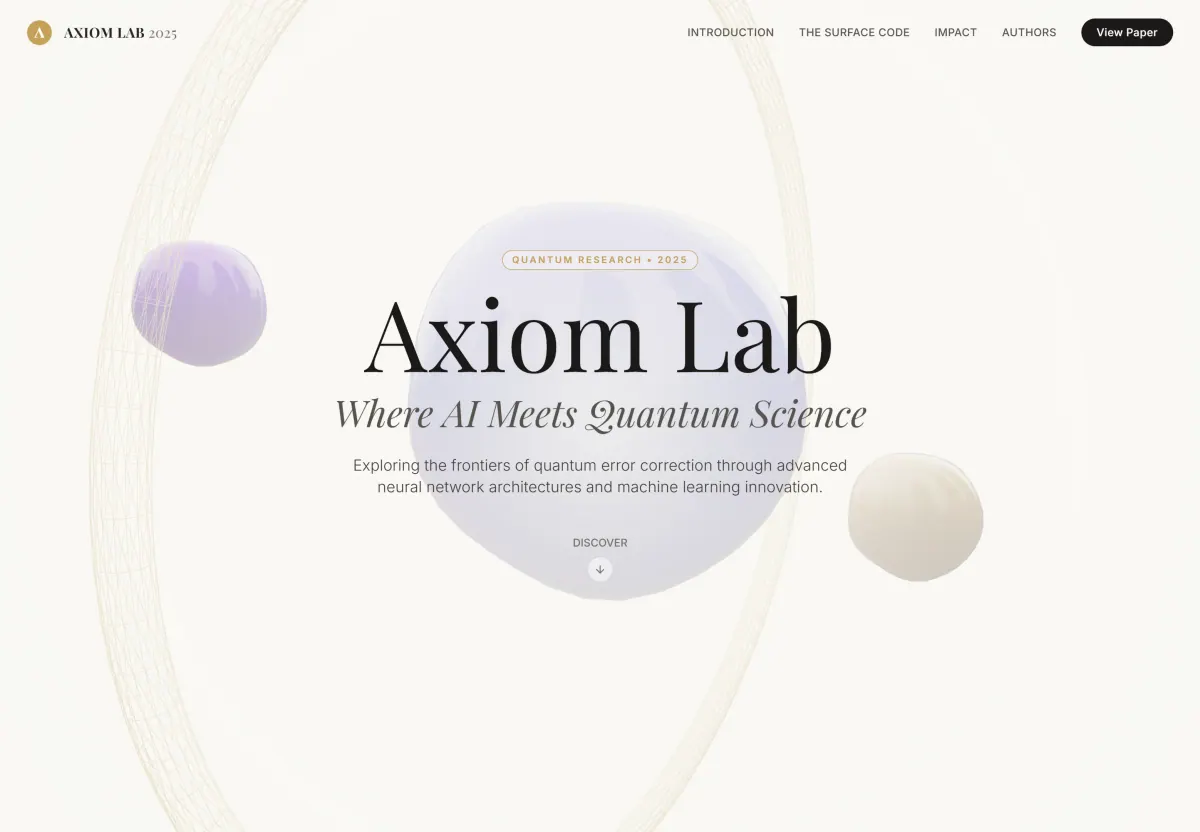
Visually we aimed for a calm scientific journal: an ivory background, serif headings, a drop cap on the opening paragraph and a gold accent used sparingly. The section on the new idea sits on a dark background to mark the turning point of the story. Colours in the chart keep a fixed meaning: gold for Axiom Lab's results, grey for the method it is compared with.
We chose React because each interactive component holds its own state, such as which qubit has an error or which code distance is selected. The 3D models are built with Three.js and rendered in the browser, so they stay sharp on high-resolution screens without any video files. Framer Motion handles transitions so movement feels the same across the page.
The solution
The result is a single-page web application with seven sections. Readers can click a data qubit to inject an error and watch the checks light up, follow a four-step diagram from syndrome to correction, then compare the logical error rate of Axiom Lab's decoder with the standard method at code distances 3, 5 and 11.
The impact section closes with a 3D model of the quantum processor environment and a quote from a published study, with its source. The Axiom Lab team can now share one link in presentations, at conferences and with prospective partners.
What we built
- Opening section with 3D shapes rendered in Three.js
- Surface-code simulation: click a data qubit to inject an error
- Four-step architecture diagram, from syndrome to correction
- Error-rate chart with code distance 3, 5 and 11 options
- 3D model of the quantum processor environment in the impact section
- Sticky menu with links to every section and a View Paper button
- Journal-style typography: serif headings, drop cap, sourced quotes
Scope
- Research storyline mapping
- Information architecture
- UI/UX design
- 3D modelling & animation
- Interactive component development
- Cross-browser testing
Screens
/ 5
Next project
HORIZONS — company profile website for a technology firm
Tell us about your business.
We will help you pick the first step.
Free, no strings attached. We reply the same day.